
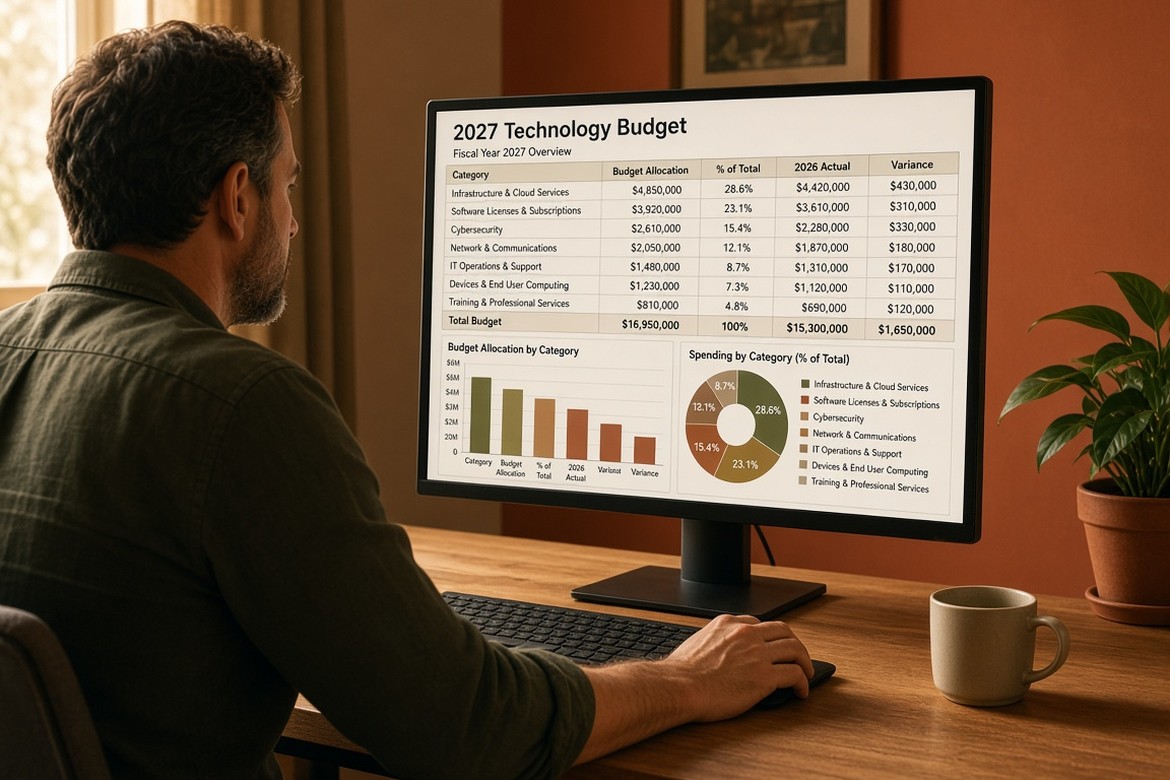
Every year the same thing happens. Budget season arrives, last year's numbers get copied forward, a few percent gets added or trimmed, and a short list of new initiatives competes for whatever is left. For 2027 that habit is riskier than usual. AI has changed what teams expect to build, older systems are getting more expensive to keep alive, and leadership wants to see returns, not experiments.
A good 2027 technology budget is less about the total amount and more about how the money is divided. The organizations that get the most from their spending tend to make a few deliberate choices up front: what must keep running, what is holding them back, what foundation they need, and where they actually want to grow. This guide walks through those choices in plain terms.
Start With What You Already Spend
Before adding anything new, get an honest picture of the current run cost. That means more than license renewals. Include hosting, support contracts, the internal hours spent keeping older applications running, and the time engineers lose to recurring incidents and manual workarounds.
This step often surprises people. A large share of most technology budgets goes to simply maintaining what exists, and that share tends to grow when aging systems are left alone. If you do not see it clearly, every new initiative ends up competing with costs nobody chose to fund on purpose.
A few questions help here:
- Which systems cost the most to support relative to the value they deliver?
- Which platforms are near the end of vendor support or depend on scarce skills?
- Where do teams repeat manual work that software could handle?
- Which applications are blocking projects because they are hard to change or integrate?
Sort Spending Into Four Buckets
A simple way to make trade-offs visible is to group every line item into one of four buckets. The exact split will vary by company, but naming the buckets forces a real conversation about balance.
The common mistake is to treat the first and last buckets as the whole budget. Run costs feel mandatory and growth feels exciting, so debt reduction and foundation work get squeezed. That works for a year or two. Then the foundation becomes the reason growth projects stall.
Treat Technical Debt as a Budget Line
Technical debt rarely appears in a budget by name, which is exactly why it keeps growing. It shows up instead as slower releases, higher support costs, and projects that take longer than planned. We have written before about why technical debt is a business problem, and budget season is the right time to act on that idea.
Give debt reduction its own line with clear targets. For example, retire one fragile integration per quarter, move one unsupported application to a maintained platform, or remove the top recurring incident. Small, visible goals are easier to defend than a vague modernization program, and each one frees up capacity for the rest of the plan.
Fund AI Where It Can Reach Production
Most leadership teams will want an AI line in 2027, and they should have one. The question is how to spend it well. Spreading money across many small pilots usually produces demos rather than results. A better approach is to pick a few processes where the value is easy to measure, such as handling routine requests, reviewing documents, or speeding up internal workflows, and fund them through to production.
That also means budgeting for the work around the model. AI tools and agentic AI systems need clean data, reliable APIs into core systems, access controls, monitoring, and people who own the outcome. If those pieces are missing, the AI line will quietly depend on the foundation bucket. Plan for both together, and the connection between them becomes a strength instead of a surprise.
Questions to Ask Before Approving an AI Project
- Which process will change, and who owns it?
- How will we measure success after three and six months?
- Does the data it needs exist, and can the project reach it safely?
- What will it cost to run once it is live, not just to build?
Plan Capacity, Not Just Projects
A budget can approve ten initiatives and still deliver three if the team cannot absorb the work. Before finalizing priorities, compare the planned projects against the engineering capacity you actually have, including the time already committed to support and maintenance.
When the gap is large, there are a few realistic options: reduce scope, phase the work across the year, or add capacity. Many companies now use dedicated or augmented engineering teams in overlapping time zones to handle modernization, integration, or AI work alongside their internal staff. That approach keeps core teams focused on the roadmap while specific initiatives move forward at a steady pace.
Build in Checkpoints
Annual budgets are set once, but priorities shift during the year. Instead of locking every dollar in January, plan quarterly checkpoints where each funded initiative shows progress against the goals it was approved for. Projects that are working can get more support. Projects that are not can be adjusted or stopped before they consume the rest of their allocation.
Consider a mid-sized company planning a customer portal, a new reporting tool, and two AI pilots for 2027. After mapping its run costs, it finds that an aging order system causes frequent incidents and makes every integration slow. Rather than fund all four projects at once, it moves the order system work to the front of the year, launches one AI pilot that does not depend on it, and starts the portal once the new APIs are in place. The total budget barely changes, but the odds of each project finishing on time improve.
A Simple Planning Checklist
- Map current spend, including hidden support time and recurring incidents.
- Sort every item into run, debt, foundation, or growth.
- Set debt targets that are small, specific, and measurable.
- Choose a few AI use cases and fund them through to production.
- Match plans to capacity and decide how to close any gap.
- Schedule quarterly reviews so funding follows results.
None of this requires a bigger budget. It requires a clearer one, where every dollar has a reason and an owner. Strong integration and data foundations make that easier, because new initiatives stop paying the same setup costs again and again.
How DevWise Can Help
DevWise works with organizations to turn technology plans into delivered software. Our teams build custom applications, APIs and integrations, data platforms, and AI automation, and we help modernize the legacy systems that consume too much of the run budget. Through our digital transformation work and dedicated engineering teams, we add capacity where your plan needs it without pulling your staff off their priorities.
If you are shaping your 2027 technology budget and want a second opinion on priorities, sequencing, or capacity, talk with DevWise about building a plan your teams can actually deliver.


