
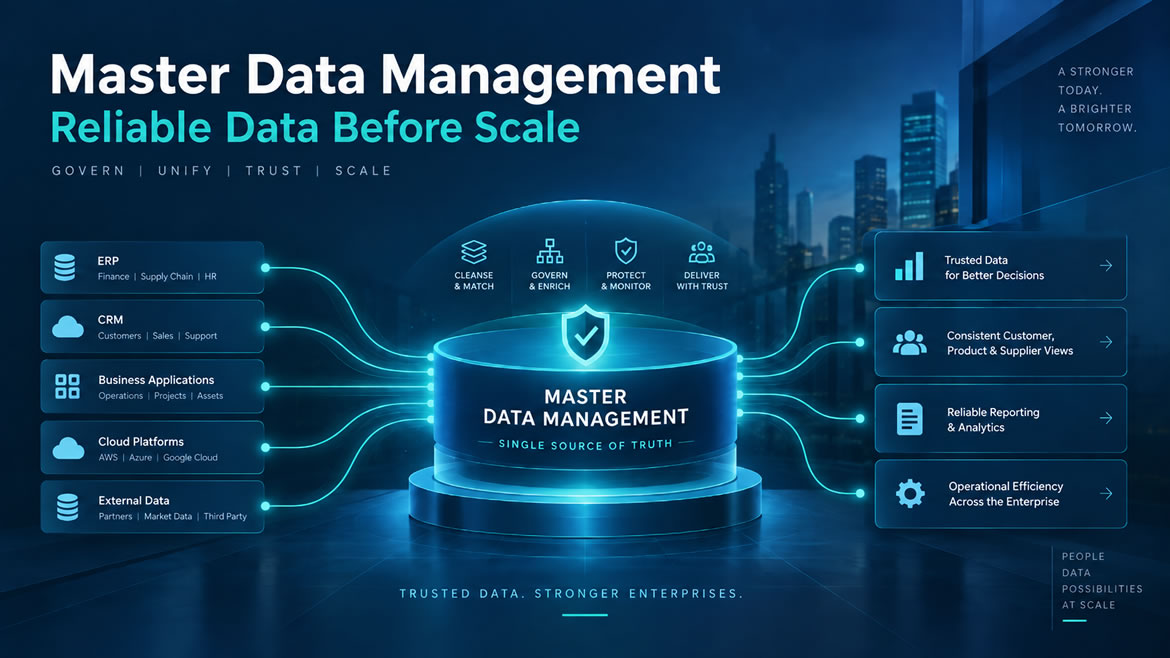
Most enterprises do not lack data. They lack agreement on which customer, product, supplier, or location record is the one that counts. When CRM, ERP, billing, and support each carry a slightly different version of the same entity, dashboards disagree, campaigns misfire, and AI projects inherit the mess. Master data management turns that fragmentation into a governed source of truth.
This article is for executives and IT decision-makers who need cleaner master records without treating MDM as a multi-year science project. It covers what MDM actually owns, where it pays off, how it differs from warehouses and one-off cleanup, and how a delivery partner like DevWise can help you design, implement, and staff the work.
What Master Data Management Really Owns
Master data is the shared vocabulary of the business: customers, accounts, products, materials, suppliers, employees, sites, and similar entities that many applications reference. Transactional systems generate events and documents; master data defines who and what those events are about.
MDM is the discipline and tooling that:
- - Models those entities and their relationships once, with clear ownership.
- - Matches and merges duplicates that arrived from different channels or acquisitions.
- - Cleanses and enriches attributes so formats, codes, and hierarchies stay usable.
- - Synchronizes trusted values back to consuming systems on a controlled cadence.
- - Governs change—who may create, edit, approve, or retire a master record.
Done well, MDM is not a second CRM. It is the backbone that keeps every system honest about the same real-world entity.
Why Leaders Put MDM on the Roadmap Now
Three pressures show up repeatedly in enterprise conversations:
- Integration debt after growth. Mergers, new channels, and SaaS sprawl multiply golden-record candidates. Point-to-point fixes hide the problem until a board report or regulatory review forces a recount.
- Analytics and AI that need stable keys. Models and copilots amplify whatever identity and hierarchy quality you feed them. Unreliable masters produce confident nonsense at scale.
- Customer experience that spans systems. Service, sales, and finance cannot deliver a coherent journey if each team works from a different customer ID and status.
MDM will not replace your ERP or CRM. It reduces the cost of keeping them aligned so product, risk, and revenue teams can trust what they see.
Signs Your Organization Needs More Than Another Cleanup Sprint
Consider a structured MDM approach when you see patterns like these:
- - The same legal entity appears under three names in CRM, ERP, and the data warehouse—with no agreed survivor.
- - Product hierarchies differ between catalog, pricing, and inventory, so forecasts and promotions never quite match.
- - Onboarding a new system requires weeks of manual mapping because there is no shared customer or site key.
- - Data stewards spend most of their time in spreadsheets, not in a governed workflow with audit history.
- - AI or Customer 360 initiatives stall on identity resolution before anyone debates models or UI.
If those symptoms sound familiar, another one-off dedupe script will buy quiet for a quarter and then return as operational noise.
How This Differs From Other Approaches
Leaders often confuse MDM with neighboring investments. The distinctions matter for budget and accountability.
Warehouses remain valuable for history and analytics. Cleanup sprints remain useful as discovery. Neither substitutes for an owned master that applications can consume day to day.
A Practical Path That Fits Delivery Reality
Enterprises that get value from MDM tend to sequence work tightly rather than boil the ocean.
Start with one domain and clear outcomes
Customer or product is the usual first domain. Define success in business language: fewer duplicate accounts in sales, cleaner hierarchy for pricing, faster onboarding of a new channel. Scope the attributes that matter now; defer exotic enrichment until the core identity loop works.
Design the hub and ownership model together
Architecture choices—central hub, registry style, or coexistence with domain services—should follow how your systems create and update records today. Equally important: name stewards, escalation paths, and what “golden” means for each critical attribute. Technology without ownership recreates the same conflicts inside a prettier UI.
Match, merge, then synchronize with care
Matching rules need business review, not only algorithm tuning. Merge policies should preserve auditability. Synchronization should start with the highest-value consumers and include rollback and conflict handling. Quiet overnight overwrites of production CRM fields are how MDM programs lose political capital.
Treat governance as product work
Policies, quality scores, exception queues, and steward dashboards deserve the same backlog discipline as features. If governance is a slide deck, operational teams will route around it.
Staff for integration and stewardship, not only licenses
MDM platforms help, but delivery capacity—data architects, integration engineers, and people who can sit with business stewards—determines whether the hub stays accurate after go-live. Partner teams that already collaborate across overlapping hours make that work practical without stretching internal specialists thin.
What Good Looks Like After Go-Live
You know an MDM investment is landing when:
- - New systems ask for the master key instead of inventing another local ID.
- - Stewards resolve exceptions in a workflow with history, not email threads.
- - Downstream analytics and AI projects spend less time debating which customer row is correct.
- - Mergers and channel launches reuse matching and sync patterns instead of starting from zero.
- - Cost conversations shift from “who maintains these spreadsheets?” to “which domain do we extend next?”
Those outcomes are operational, not decorative. They show up in cycle time, dispute rates, and the confidence leaders place in cross-system reports.
How DevWise Supports MDM Programs
DevWise helps organizations that need engineering depth around master data—not only a tool recommendation. Typical engagement shapes include:
- - MDM consulting and hub architecture aligned to your CRM, ERP, eCommerce, Website and legacy landscape.
- - Data analysis to surface inconsistencies, gaps, and a simplified target model.
- - Implementation spanning migration, consolidation, governance workflows, and integration services—including Customer 360–oriented customer MDM.
- - Staff augmentation and dedicated teams so architects and engineers can execute beside your stewards across overlapping time zones.
The goal is a living master that your applications and analytics can trust—not a one-time cleanup report that ages poorly.
If fragmented customer or product data is slowing decisions, integrations, or AI readiness, a focused MDM conversation is a practical next step. Learn more about how DevWise approaches enterprise data and delivery at https://www.devwise.co.


