
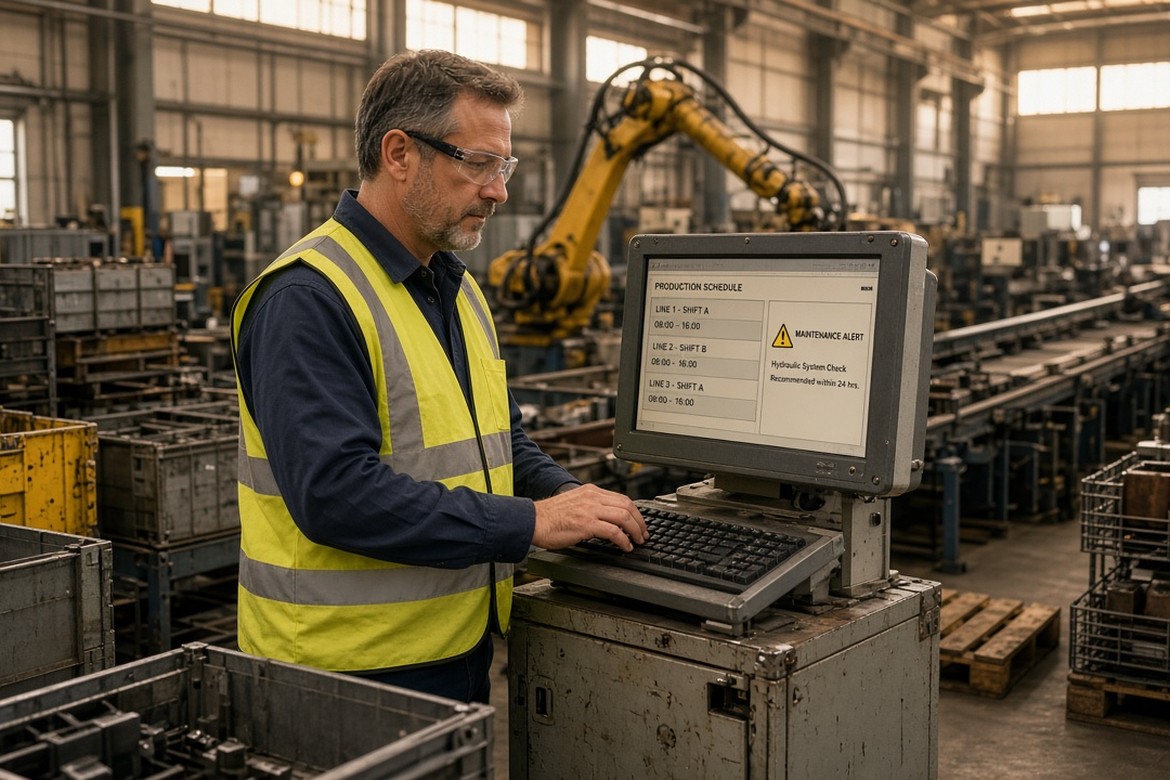
Plant managers already live with sensors, automation, and tight production schedules. What is new is software that can plan a sequence of steps, check the systems on the floor, and recommend or take action when conditions change. Agentic AI can improve a manufacturing process in scheduling, quality, maintenance, inventory, and changeovers, as long as people keep control of the high-impact decisions on the line.
The value is not another dashboard. You already know when the line is behind. The value is an agent that can look across the schedule, quality system, maintenance history, and warehouse, then propose a next step you can accept, edit, or reject. Below are five process areas, with the approvals and data each needs.
What Agentic AI Means on the Plant Floor
Most plants already have automation: controllers on the equipment, supervisory systems for status, and rules that move data between the manufacturing execution system, the ERP, and the maintenance system. Those tools do a defined job the same way every time.
An agent is different. It can plan a short sequence of steps, call those systems, read the results, and decide what to do next. When a line stops, it might check maintenance history, the work queue, and downstream inventory, then propose a new sequence for the rest of the shift. Treat it as a shift assistant, not a replacement for the supervisor: it prepares the work, stays inside your rules, and waits when the next step would change labor, a customer promise, product disposition, or a maintenance window. If you already use fixed workflow automation or robotic process automation in the plant office, an agent can sit beside those tools. See AI workflow automation vs RPA.
Five Process Areas Worth Starting With
A practical agentic AI manufacturing process starts in one area, not across the whole plant. Pick a process with clear rules, frequent decisions, and data in systems people trust. The table below shows how an agent can help in five common areas, where a person should still approve the action, and what data the agent needs.
In each row, the agent does the gathering, comparing, and drafting that slow a team down. A person keeps the decision that affects safety, quality, cost, or a customer.
Production Scheduling
Schedulers and supervisors spend much of the day reacting: a machine goes down, a rush order arrives, a supplier misses a delivery, or a quality hold takes inventory out of play. The plan that looked good at the start of the shift is often stale by mid-morning.
An agent can watch those signals and rebuild a feasible plan against machine calendars, labor rules, changeover constraints, and component availability, then show what will finish on time, what will slip, and why. Keep a person in the loop when the new plan would add overtime, move work to another line, change a customer promise date, or idle a crew. The data is ordinary: work orders, routings, calendars, inventory, and the constraints your planners already apply. If those constraints live only in someone's head, write them down first.
Quality Inspection and Deviation Handling
When a reading is out of spec, someone has to pull the lot history, recent process parameters, similar past events, and hold status, then write the record and recommend containment. An agent can do that first pass: flag the result, gather the related data, draft the deviation, and recommend a hold, extra sampling, or a check on adjacent lots. It can also surface a repeating drift on the same equipment.
People should still decide how to disposition nonconforming product, whether to change a process, and whether a customer or a release needs a notice. Those are quality and compliance decisions, not drafting tasks. The agent needs inspection results, specifications, process data, lot genealogy, and prior deviations. Incomplete genealogy is a common reason the draft is not trusted.
Predictive Maintenance
Unplanned downtime is still one of the most expensive surprises on a plant floor. Many sites already collect vibration, temperature, and cycle data. The gap is turning those signals into a work order that fits the production calendar and the parts crib, early enough to act.
An agent can watch trends against the maintenance history, propose a work order with a recommended window, and check spare parts, skills, and whether a planned changeover would make the stop less painful. It can attach recent alarms, last service notes, and the last procedure used. A maintenance or production lead should approve taking a critical line down, deferring a job, or moving a planned window. The agent should not silently cancel a scheduled service or keep a failing asset running. If the historian and maintenance system lack a common asset identifier, fix that mapping first.
Supply and Inventory Replenishment
A good schedule still fails when the parts are not there. Planners already compare the production plan to on-hand stock and open purchase orders, and that work gets hard when many SKUs, long lead times, and last-minute schedule changes all move at once.
An agent can run the comparison continuously, flag a shortage against the current sequence, propose a replenishment quantity or a substitution the bill of material allows, or warn that a rush order will starve a later job. People should approve expedites that add cost, a change of supplier, a substitution that could affect quality or labeling, and any change to safety stock policy. Inventory, bills of material, lead times, open orders, and demand from the schedule have to be timely. Stale warehouse data will make the agent look sure and still be wrong.
Changeovers
Changeovers are where a lot of available capacity disappears. The steps are often known: tools, settings, cleaning, staging, and quality checks. The delay comes from missing tooling, hunting for last-run settings, or a product sequence that forces extra cleanup.
An agent can assemble the plan from the playbook and from what happened last time, confirm tooling status, propose settings, and suggest a sequence that reduces major changeovers in the shift. Before the stop, it can check that the next material is staged and that quality checks are ready. A supervisor should approve a new sequence that changes today's output, and no agent should skip a required cleanup or quality check to save minutes. If unofficial methods differ by line, standardize the official steps first so the agent follows a method the plant already stands behind.
What Has to Be True Before You Start
Agents do not fix broken data, and they spread a bad number faster. Before you pick a first process, confirm that the records are trustworthy, owned, and reachable through a controlled interface. If you are unsure, assess AI data readiness on the systems behind that process, not plant-wide.
Integration is the other prerequisite. An agent that can only see one system will recommend plans the rest of the plant cannot execute. Scheduling needs inventory and maintenance; maintenance needs the production calendar; quality needs genealogy and process data. A durable integration strategy with clear APIs and event flows beats a one-off connection built for a demo. Write approval rules into the design. If a step can affect safety, quality release, a customer promise, or a meaningful cost, the agent waits. If the step is routine and reversible, it can proceed inside tight limits and still be logged.
Start on One Process, in Shadow First
Pick one area where people already spend time gathering information and comparing options, and where a wrong recommendation is visible and recoverable. Scheduling for a single line, deviation drafting for one product family, or maintenance proposals for a known set of assets are reasonable first scopes.
Run the agent in shadow or recommend mode long enough for supervisors to see how it behaves on real shifts. Compare its proposals to what the team actually did, using measures you already review in the daily production meeting, such as schedule adherence, downtime, or changeover duration. Bring operators, quality, and maintenance into the design early. They know the exceptions that official procedures leave out. When the recommendations are consistently sound, let the agent take the next step, still inside the approval points in the table above.
How DevWise Helps
DevWise designs and builds agentic AI solutions that connect to the systems already running in your operation. Our AI-first development teams, including nearshore engineers working in overlapping hours, add the integrations, approval checkpoints, and activity logs that make an agent usable on a plant floor, not only in a pilot.
We can deliver the project end to end or add experienced engineers through dedicated and augmented teams. If you want to improve one manufacturing process with a practical first agent, talk with our team about a focused starting point.


