
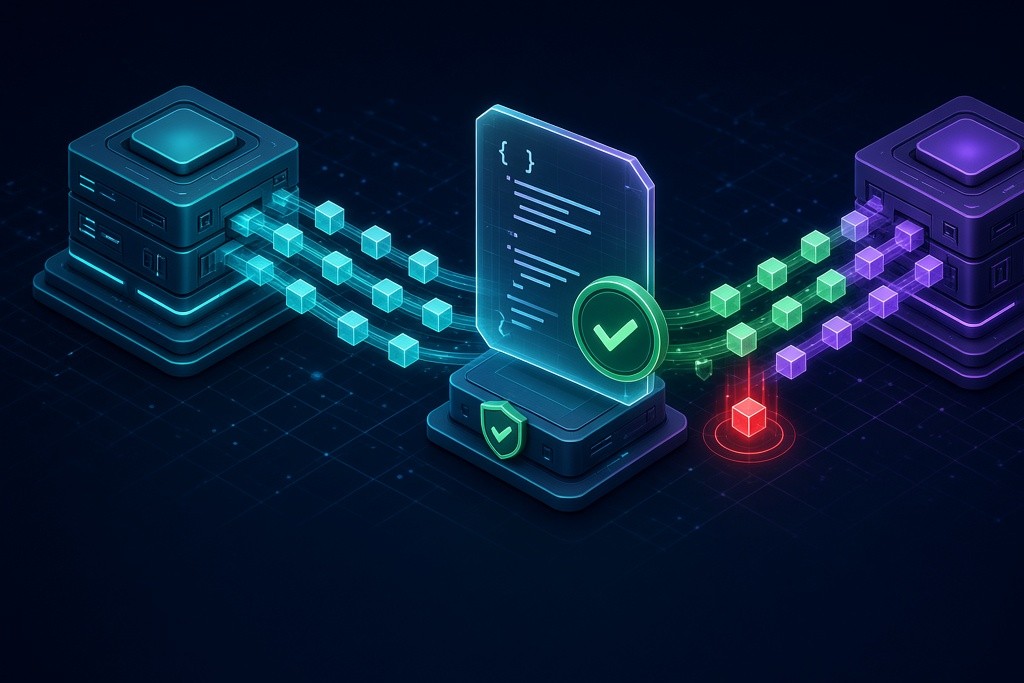
Most incidents between systems do not start with a crash. They start with a small change: a renamed field, a stricter validation rule, a status code that now means something else. One team ships, another team's integration quietly breaks, and customers notice first. API contract testing gives every team a shared, automated agreement about what each service promises, so changes ship without surprises.
Why APIs Break Between Teams
Inside a single codebase, a compiler or a test suite usually tells a developer when a change breaks something. Across services, that safety net disappears. The team that owns an API rarely knows every system that calls it, and the teams that depend on it rarely hear about changes until something fails.
The result is a pattern most IT leaders will recognize. Releases slow down because nobody trusts a change until it has been tested together with everything else. Shared staging environments become crowded and unreliable. Teams start coordinating releases by meeting instead of by evidence. The architecture was supposed to let teams move independently, yet in practice they are tied together by fear of breaking each other.
None of this is a people problem. It is a missing agreement. Each API makes promises about fields, formats, error codes, and behavior, but those promises live in documentation, in tribal knowledge, or nowhere at all. When the promise is not written down in a form a machine can check, it gets broken by accident.
What API Contract Testing Actually Checks
A contract is a precise description of how two systems talk: the request a consumer sends, the response it expects, and the parts of that response it actually uses. Contract testing turns that description into an automated check that runs every time either side changes.
There are two common styles. In consumer-driven contracts, each consuming team records what it needs from the API, and the provider runs those expectations against its own build before release. If a change would break a consumer, the provider finds out in minutes, not after deployment. In provider-driven contracts, the API team publishes a formal specification, such as an OpenAPI document, and automated checks confirm that the real service matches it and that changes to it stay backward compatible.
The key difference from end-to-end testing is isolation. Contract tests do not need every service running at once. Each side is verified on its own, against the shared agreement, which makes the checks fast, stable, and cheap enough to run on every commit.
Comparing the Main Testing Approaches
Contract testing does not replace other kinds of testing. It fills a specific gap between them. This comparison shows where each approach earns its place.
Most organizations already have unit tests and some end-to-end coverage. The gap is usually in the middle, which is exactly where breaking changes between teams live.
Why AI Raises the Stakes
AI coding assistants have made it easier and faster to change code, including code that defines APIs. A developer can refactor a service, rename fields for clarity, or tighten validation in an afternoon. That speed is valuable, but it also means more changes reach the boundary between systems, and an assistant working inside one repository has no view of the consumers outside it. As we noted in Faster Code Isn't Faster Delivery, writing code faster does not help if the change still breaks something downstream.
AI agents add a second pressure. When agents call internal APIs to look up orders, update records, or trigger workflows, they become consumers too. An agent does not file a support ticket when a response format changes. It may simply act on the wrong data. Clear, tested contracts are what make APIs safe to expose to agentic AI, because they give both people and agents a stable, verified surface to build on.
There is an upside as well. A machine-readable contract is excellent input for AI tools. Assistants can generate client code, test cases, and mock servers from a good specification, and they can flag a proposed change that would violate it before a human reviewer even opens the pull request.
Where to Start
Contract testing works best when it grows from real pain rather than a company-wide mandate. A focused rollout builds trust and shows value quickly.
Pick the Integrations That Hurt Most
Look at recent incidents, rollbacks, and delayed releases. Which service boundaries keep showing up? Start with two or three high-traffic internal APIs where the consumers are known and the teams are willing to try a new practice. Avoid starting with the most political or most fragile system in the company.
Decide Who Owns the Contract
Every contract needs a clear owner and a clear process for change. For internal APIs with a handful of consumers, consumer-driven contracts usually work well because they capture what is really used. For partner or public APIs, the provider should own a published specification and treat it as a product. Either way, write the rule down: who can change the contract, who must approve, and how consumers are told.
Put the Check in the Pipeline
A contract that is checked only when someone remembers is not much better than documentation. Add verification to the build pipeline on both sides. A provider build should fail if it breaks a published consumer expectation, and teams should be able to ask a simple question before any deployment: is this version compatible with what is running in production right now?
Keep Contracts Close to the Code
Store contracts and specifications in version control next to the services they describe, and review changes to them like any other code. A contract that lives in a forgotten wiki page drifts within weeks. When the contract changes in the same pull request as the code, reviewers see the impact on consumers immediately, and the history of every promise stays easy to trace.
Plan for Versioning and Deprecation
Some breaking changes are necessary. Contracts make them visible, but you still need a policy for handling them. Prefer additive changes, such as new optional fields, over renames or removals. When a breaking change is unavoidable, run old and new versions side by side, publish a retirement date, and use contract data to confirm which consumers have moved before switching anything off. This fits naturally into a wider integration strategy that treats interfaces as long-lived assets.
A Retail Order Platform Example
Consider a mid-sized retailer with an order service used by its web store, its mobile app, a warehouse system, and a customer service tool. The order team wants to split a single address field into structured parts to support new delivery options. In the past, a change like this meant weeks of coordination meetings, a shared test window, and a nervous release night.
With contracts in place, each consumer has already recorded what it reads from the order response. The order team adds the new structured fields alongside the old one and runs the provider build. The checks pass for the web store and the app, which only read the new format through a shared library, but fail for the customer service tool, which still parses the old field directly. The team now knows exactly who needs to change, before anything ships. The old field stays until the contract data shows the last consumer has moved, and then it is removed in a routine release.
Nothing about this is dramatic, and that is the point. The change became a normal piece of work instead of a coordinated risk.
Signs It Is Working
You do not need invented benchmarks to see whether contract testing is paying off. Watch for practical signals over a few release cycles:
Fewer integration surprises. Incidents caused by changes between services become rare, and when they do happen, the post-incident review points to a gap in a contract rather than an unknown dependency.
Independent releases. Teams deploy on their own schedule without waiting for a shared test window or a cross-team sign-off meeting.
Smaller staging burden. End-to-end suites shrink to the journeys that truly matter, and shared environments stop being a bottleneck.
Clearer conversations. When a provider wants to change something, the discussion starts from data about who uses what, not from guesses.
If none of these move after a few months, look at adoption before tooling. The most common failure is a contract suite that exists but is not wired into the pipeline, or a consumer team that never published its expectations.
How DevWise Can Help
DevWise helps companies design, build, and test the APIs that connect their systems, from custom software and data platforms to modernization of older applications and integrations ready for AI agents. Our engineers can assess where breaking changes keep hurting you, introduce contract testing into your existing pipelines, and coach your teams to own it as part of broader digital transformation work.
If you need extra capacity, our dedicated teams work in overlapping time zones with clients across the Americas and Europe and fit into your existing delivery process. To talk about making your releases safer without slowing them down, contact DevWise.


